5-Day Marangu Route
The shortest standard climb of Kilimanjaro: hut nights at Mandara, Horombo and Kibo, then summit night via Gilman's Point to Uhuru Peak and back down the same trail. Gentle walking, but a fast altitude profile.
- Duration
- 5 days
- Route
- Marangu Route
- Highest point
- 5,895 m
- Difficulty
- Challenging
- Climb style
- Private
The five-day Marangu Route is the quickest way up and down Kilimanjaro that the park allows; TANAPA says climbers must spend at least five days to go up and down Kibo. You sleep in shared huts at Mandara (approx. 2,720 m), Horombo (approx. 3,720 m) and Kibo (approx. 4,720 m), climb to Uhuru Peak (5,895 m) via Gilman's Point on the fourth night, and walk back out to Marangu Gate on day five. Most people spend the night before the climb in a hotel in Moshi or Arusha for a briefing and kit check, and return to one afterwards.
The walking is gentle, with no scrambling and a roof every night. The problem is altitude. You go from about 1,860 m to sleeping at about 4,720 m in three days, which is well beyond the 300–500 m of sleeping altitude per day above 3,000 m that altitude-medicine guidance suggests. A study of 312 trekkers on four- and five-day Marangu climbs (Davies et al., 2009) found 77% of those with complete data developed acute mountain sickness and 61% reached the summit.
For most climbers the 6-day Marangu Route or a longer route. It can suit someone who has recently been to high altitude, for example after climbing Mount Meru.
Highlights
- The only Kilimanjaro route with hut accommodation
- Gentle, well-made path with no scrambling
- Maundi Crater viewpoint a short walk above Mandara Hut
- Crossing the Saddle between Mawenzi and Kibo
- Summit via Gilman's Point and Stella Point to Uhuru Peak (5,895 m)
- Short trip that fits a tight holiday, if you accept the altitude risk
Day 1: Marangu Gate to Mandara Hut
You leave your hotel after breakfast for the drive to Marangu Gate (approx. 1,860 m), which is also the headquarters of Kilimanjaro National Park. TANAPA puts the gate 41 km from Moshi, so the road part is short from Moshi and longer from Arusha. At the gate your guide sorts out the permits while you sign the park register and the porters have their loads weighed; park rules cap a porter's load at 25 kg.
The walk to Mandara Hut (approx. 2,720 m) is about 8 km (approx.) and usually takes 3–5 hours (approx.). A broad path climbs steadily through montane forest: tall trees draped in moss, ferns, running streams and, with luck, black-and-white colobus monkeys in the canopy. The gradient is gentle, which is exactly why you should walk slower than feels necessary. The goal today is to arrive fresh, not first.
Mandara is a group of wooden huts in a forest clearing. If you still have energy, TANAPA notes that Maundi Crater is about 15 minutes' walk beyond the huts, with views towards Lakes Chala and Jipe on a clear afternoon. Then dinner, a short briefing on tomorrow and an early night in a shared bunk room.
- From
- Marangu Gate
- To
- Mandara Hut
- Altitude
- 2,720 m
- Walking
- 3–5 hours hours
- Distance
- 8.0 km
Day 2: Mandara Hut to Horombo Hut
The trail leaves the forest within the first hour and opens into heath and moorland: giant heather, tussock grass and, higher up, the first giant groundsels and lobelias. On a clear morning you get your first proper view of Kibo's snow-streaked dome ahead and the jagged rock of Mawenzi to the right. The distance to Horombo Hut is about 12 km (approx.), usually 5–7 hours (approx.) on a well-worn path with no steep sections.
This is a gain of about 1,000 m in sleeping altitude, the largest so far, and many people notice it as a mild headache or breathlessness on short rises. Keep the pace slow enough to hold a conversation, drink regularly and eat lunch even if you are not hungry. Tell your guide about every symptom, however small. In a 2022 cohort study of Kilimanjaro hikers, the response to mild symptoms linked with fewer severe cases was not climbing higher until they settled.
Horombo (approx. 3,720 m) is the biggest hut camp on the route and it is busy, because descending climbers sleep here too. It often sits above the afternoon cloud, which makes for good sunsets over the moorland. Nights are noticeably colder than at Mandara, so get your warm layers and hat out before dark.
- From
- Mandara Hut
- To
- Horombo Hut
- Altitude
- 3,720 m
- Walking
- 5–7 hours hours
- Distance
- 12.0 km
Day 3: Horombo Hut to Kibo Hut
The path climbs past Zebra Rocks and out of the last of the moorland onto the Saddle, the wide, near-barren plain of gravel and lava between Mawenzi and Kibo. Plants thin out to lichens and the odd tuft of grass. It is about 10 km (approx.) to Kibo Hut, usually 5–7 hours (approx.), and the walking itself is easy. The altitude, dry air and sun are not. Wear sunglasses, sunscreen and a sun hat, and keep drinking, because the Saddle is exposed and often windy.
Kibo Hut (approx. 4,720 m) is a stone building with bunk rooms at the foot of the summit cone, and from it you can see the zigzag path you will climb tonight. You arrive here only two nights after leaving the gate, which is why the five-day plan is hard on the body. In a study of trekkers mostly on Marangu (Jackson et al., 2010), 47% had acute mountain sickness at Kibo Hut.
The evening is short. Dinner is early, around 17:00, followed by a summit briefing: layers, head torch, water bottles insulated or kept inside your jacket, snacks in a pocket. Then you try to sleep for a few hours in all your warm clothes. Most people doze rather than sleep, and that is normal.
- From
- Horombo Hut
- To
- Kibo Hut
- Altitude
- 4,720 m
- Walking
- 5–7 hours hours
- Distance
- 10.0 km
Day 4: Summit night: Kibo Hut to Uhuru Peak, down to Horombo Hut
You are woken around 23:00 for hot tea and biscuits and set off near midnight by head torch. The first hours climb tight switchbacks up steep scree and loose gravel, past Hans Meyer Cave (approx. 5,150 m). It is slow, rhythmic walking: a few steps, a breath, a few steps. Temperatures near the top are often well below freezing, and wind makes it feel colder. Water in exposed bottles can freeze.
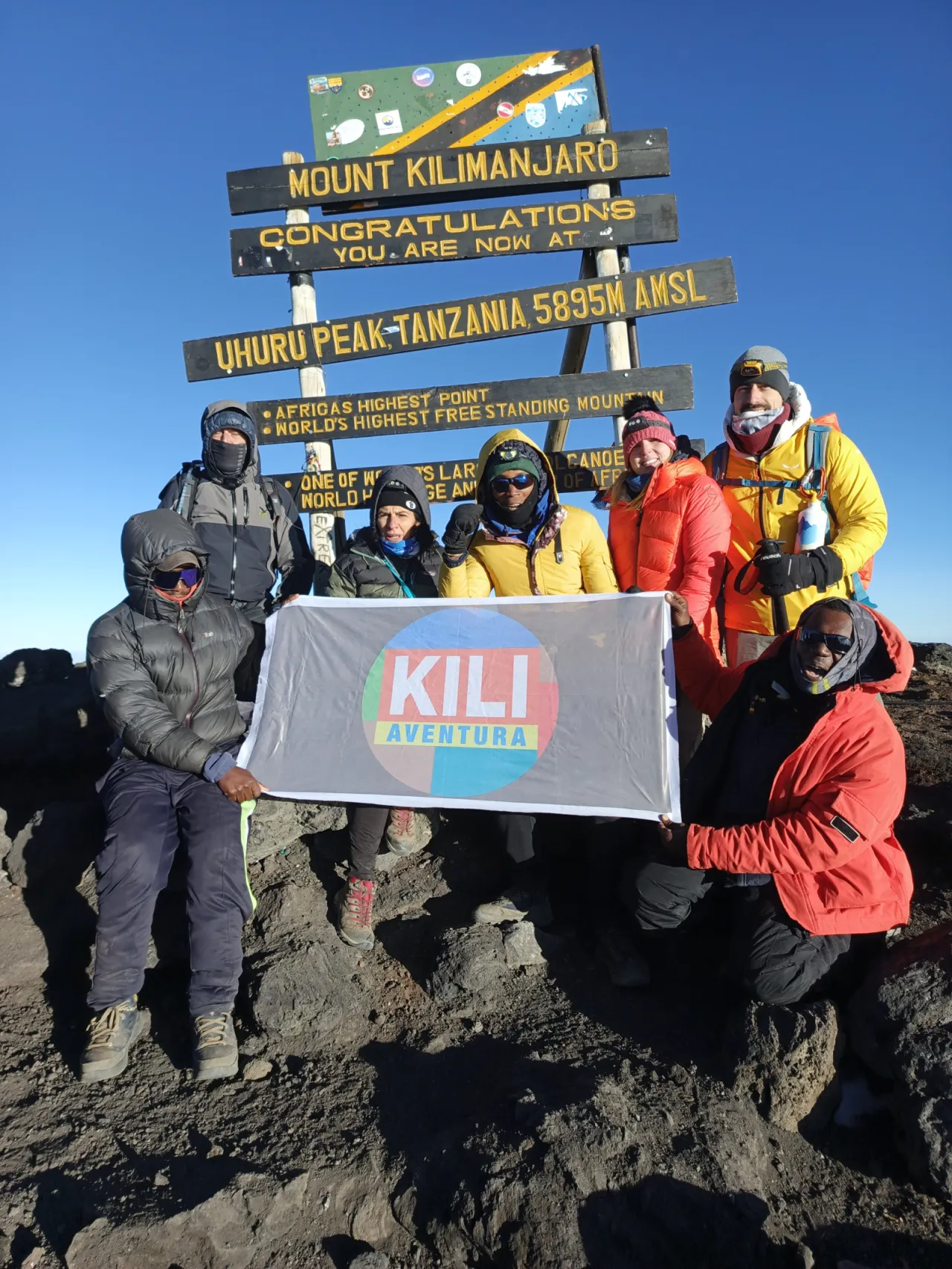
Gilman's Point (approx. 5,680 m) on the crater rim is usually reached around dawn, typically 5–6 hours (approx.) after leaving Kibo Hut. The last section involves some easy rock steps. From here the path follows the rim past Stella Point (approx. 5,756 m) to Uhuru Peak (5,895 m), the highest point in Africa, usually another 1.5–2 hours (approx.). You get a few minutes for photos by the signboard, with glaciers and the crater beside you, before starting down. Your guide will turn anyone back at any point if symptoms worsen; TANAPA's own rules tell climbers not to push on when exhausted or with severe mountain sickness.
The descent to Kibo Hut on scree is quick, then you rest, eat and continue down to Horombo Hut (approx. 3,720 m). The whole day is often 11–15 hours (approx.) and about 22 km (approx.). You will sleep very well.
- From
- Kibo Hut
- To
- Horombo Hut
- Altitude
- 3,720 m
- Walking
- 11–15 hours hours
- Distance
- 22.0 km
Day 5: Horombo Hut to Marangu Gate
After breakfast you walk the whole way back down the trail you came up, about 20 km (approx.) and usually 5–7 hours (approx.) with a break at Mandara Hut. It is a long descent of nearly 1,900 m, and the thicker air makes it feel easy on the lungs while being hard on the knees. Use your walking poles, shorten your stride on the rocky steps and take your time in the forest, where the path can be slippery after rain.
Walking down gives you a different view of the mountain. You pass climbers on their way up, notice the change back from heather and groundsels into tall forest, and start to hear birds again. Many people find their headache, if they had one, has gone by mid-morning.
At Marangu Gate you sign out of the park register, and successful climbers receive their summit certificate. This is usually where you thank and say goodbye to the crew; our tipping guide explains how that normally works. Then it is the drive back to your hotel in Moshi or Arusha for a long shower and a proper bed.
- From
- Horombo Hut
- To
- Marangu Gate
- Altitude
- 1,860 m
- Walking
- 5–7 hours hours
- Distance
- 20.0 km
Frequently asked questions
Is 5 days enough to climb Kilimanjaro?
It is the minimum the park allows, but it is not enough for most people to acclimatise well. Studies of four- and five-day Marangu climbs recorded acute mountain sickness in most trekkers and summit success of around 61%. Adding a day at Horombo Hut, or choosing a longer route, gives your body more time.
What is the difference between the 5-day and 6-day Marangu Route?
The six-day version adds a second night at Horombo Hut (approx. 3,720 m) with a day walk higher, usually to Zebra Rocks (approx. 4,000 m). The huts, trail and summit night are otherwise the same.
How long is summit night on the 5-day Marangu Route?
Expect roughly 11–15 hours from leaving Kibo Hut around midnight to reaching Horombo Hut in the afternoon. That covers about 5–6 hours to Gilman's Point, 1.5–2 hours more to Uhuru Peak and the long descent.
Who should consider the 5-day Marangu Route?
Mainly people who have recently been at high altitude, such as after a Mount Meru climb, and who are short of time. First-time high-altitude trekkers are better served by six days or more. Discuss your plans with a travel-medicine doctor either way.