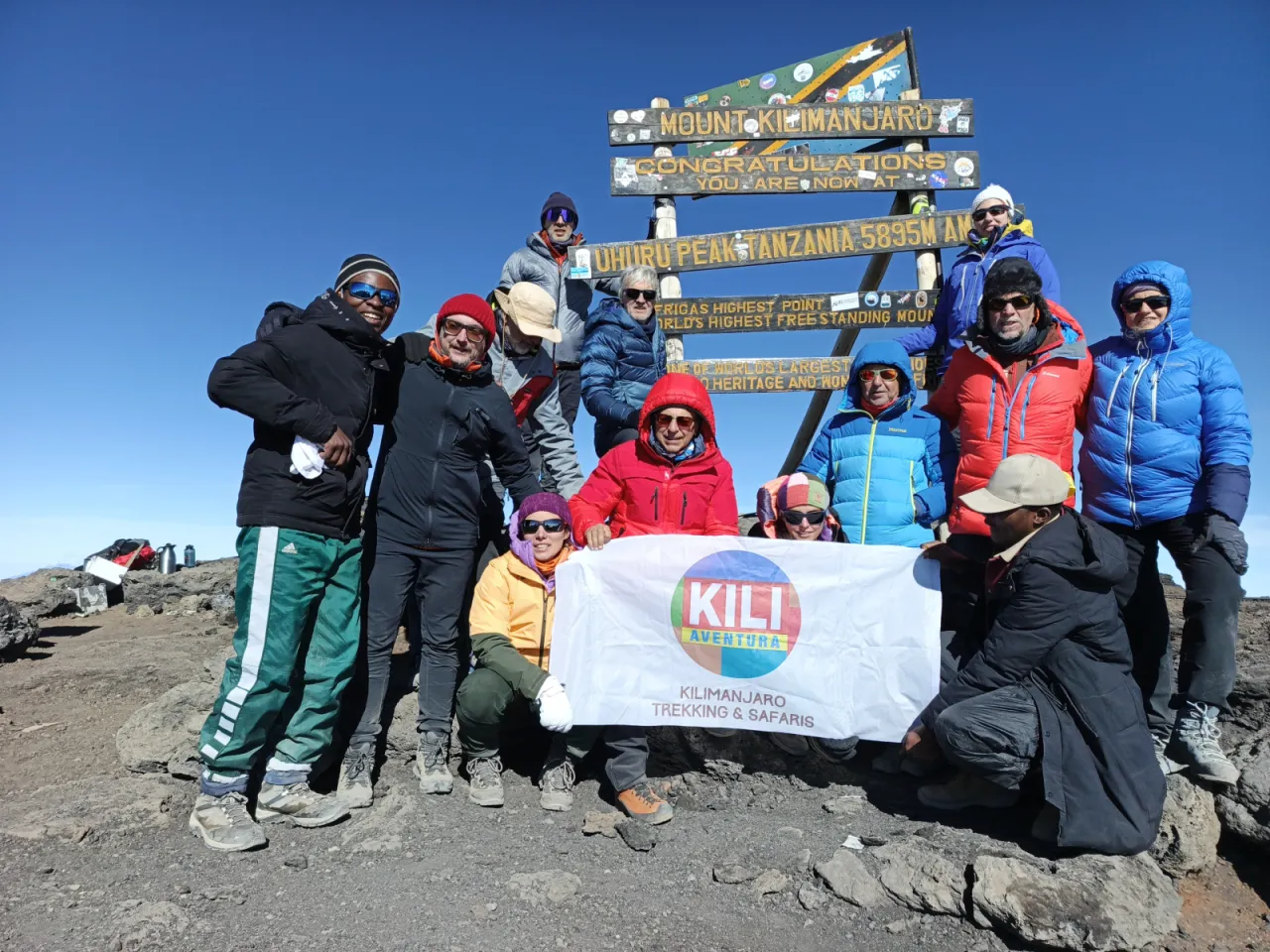
6-Day Machame Route
The faster version of Machame: rainforest, Shira 2, Lava Tower and Barranco, then straight over the Barranco Wall to Barafu Camp in one long day. Scenic and efficient, but a steep altitude profile best suited to climbers already used to altitude.
- Duration
- 6 days
- Route
- Machame Route
- Highest point
- 5,895 m
- Difficulty
- Strenuous
- Climb style
- Private
The six-day Machame climb follows the same trail as the seven-day version but skips the night at Karanga Camp. You walk from Machame Gate (approx. 1,800 m) to Machame Camp, Shira 2 and Barranco, then cross the Barranco Wall and continue all the way to Barafu Camp (approx. 4,670 m) on day four. Summit night is the night of day four into day five, and you exit at Mweka Gate on day six. As with any climb, expect a hotel night in Moshi or Arusha beforehand for the briefing and gear check, and another after you come down.
We are honest about who this suits. It works well for strong walkers who have been above 4,000 m in the last few months, or who have pre-acclimatised on Mount Meru. For a first-timer with no altitude history it is a compressed plan: day two gains about 1,000 m of sleeping altitude, and day four gains about 700 m straight after the Barranco Wall, the day before summit night. Research on Kilimanjaro hikers links shorter itineraries with lower summit success, so if you can spare one more day, the seven-day Machame is the better buy.
The Lava Tower day still gives a proper climb-high-sleep-low stimulus, and the summit push is the same: a midnight start from Barafu, sunrise near Stella Point, Uhuru Peak (5,895 m), then down to Mweka Camp.
Highlights
- The full Machame scenery in the shortest sensible time
- Montane rainforest and giant heather on the first two days
- Lava Tower (approx. 4,630 m) climb-high-sleep-low day
- Barranco Wall scramble with views over the southern glaciers
- Sunrise from the crater rim at Stella Point
- Uhuru Peak (5,895 m), the highest point in Africa
Day 1: Machame Gate to Machame Camp
After an early breakfast in Moshi you drive about an hour to Machame Gate (approx. 1,800 m), climbing through village farmland of bananas and coffee. Your guide handles park registration while the porters' loads are weighed and packed. On busy mornings this takes a while, so this is a good time to fill water bottles, apply sun cream and eat.
The trail then climbs through montane forest, the wettest and greenest zone on the mountain. The path is a mix of packed earth, roots and, in the rainy months, slippery red mud. Look up for old-man's-beard lichen trailing from the branches and listen for colobus monkeys. The gradient is steady rather than steep, but it does not let up, and you gain about 1,000 m in the day.
Pace is everything on a six-day climb. Walk slowly enough to hold a conversation, drink at every stop and resist the urge to overtake. You reach Machame Camp (approx. 2,835 m) at the upper edge of the forest in the afternoon. The crew will have tents up and hot water ready. Nights here are cool to near freezing, and dinner is usually soup, a hot main and fruit.
- From
- Machame Gate
- To
- Machame Camp
- Altitude
- 2,835 m
- Walking
- 5–7 hours hours
- Distance
- 11.0 km
Day 2: Machame Camp to Shira 2 Camp
You leave the forest behind for good this morning. The path climbs a steep, rocky spine through giant heather and heath, with occasional easy scrambles where you put a hand down for balance. On clear mornings the snow-capped dome of Kibo is ahead of you and the cloud sea is below.
This is a demanding day for acclimatisation. Sleeping altitude jumps by roughly 1,000 m, well above the 300–500 m a day that altitude-medicine guidance suggests once above 3,000 m. You cannot change the geography, but you can control the pace. Guides deliberately keep it slow, and they will ask about headaches, nausea and sleep. Answer honestly; it is how they keep you safe.
After a short lunch stop the trail eases and crosses onto the Shira Plateau, the collapsed remains of Kilimanjaro's oldest volcanic peak. Shira 2 Camp (approx. 3,850 m) is on open moorland with a wide western view. If the sky is clear, Mount Meru floats above the clouds at sunset. It freezes most nights here, so get your warm layers on early and drink plenty before dark.
- From
- Machame Camp
- To
- Shira 2 Camp
- Altitude
- 3,850 m
- Walking
- 4–6 hours hours
- Distance
- 5.0 km
Day 3: Shira 2 Camp to Barranco Camp via Lava Tower
Today is the most important acclimatisation day of a six-day climb. The trail climbs east from Shira 2 into alpine desert: grey scree, lava boulders and very little that grows. The air is thin and dry, and the sun is strong even when it feels cold, so keep sunglasses and sun cream on.
You reach Lava Tower (approx. 4,630 m), a lone volcanic plug below Kibo's western glaciers, around lunchtime. It is common to feel rough here: a headache, a heavy head, no appetite. Eat and drink anyway. You are here to give your body a high-altitude signal, not to sleep at this height.
The afternoon descent into the Barranco Valley takes roughly two to three hours (approx.) and is steep in places. Giant groundsels, some several metres tall, line the stream beds on the way down. Barranco Camp (approx. 3,960 m) sits in a sheltered valley beneath the Western Breach, facing the Barranco Wall you will climb in the morning. Because you slept at about 3,850 m last night and sleep only slightly higher tonight, many climbers notice they feel better by dinner than they did at lunch.
- From
- Shira 2 Camp
- To
- Barranco Camp
- Altitude
- 3,960 m
- Walking
- 6–8 hours hours
- Distance
- 10.0 km
Day 4: Barranco Camp to Barafu Camp via the Barranco Wall and Karanga
This is the long day that makes the six-day version six days. It begins with the Barranco Wall, a steep but non-technical scramble of an hour or two where you use your hands on some rock steps. There are no ropes. Guides place nervous climbers' hands and feet on the trickier moves, including the narrow "kissing rock" where you lean into the face to pass. Expect a queue at the bottom in high season.
From the top the trail rolls across valleys under the southern glaciers to Karanga Camp (approx. 3,995 m), where seven-day climbers stop for the night. You stop only for lunch and to refill water, since Karanga is the last reliable water source on this side.
The afternoon climb to Barafu Camp (approx. 4,670 m) is steady, dry and exposed, gaining roughly 675 m after an already full morning. You arrive tired, in the late afternoon, with only a few hours before the summit wake-up call. Eat a proper dinner even if you do not feel like it, listen to the summit briefing, lay out every layer in the order you will put it on, and be in your sleeping bag by about 19:00.
- From
- Barranco Camp
- To
- Barafu Camp
- Altitude
- 4,670 m
- Walking
- 7–8 hours hours
- Distance
- 9.0 km
Day 5: Summit day: Barafu Camp to Uhuru Peak, down to Mweka Camp
A wake-up call around 23:00, tea and a biscuit, and you are walking by about midnight. The route to Stella Point on the crater rim climbs roughly 1,080 m on tight switchbacks through scree and broken rock. Everything happens in the circle of your head torch. The pace is painfully slow, and it should be; guides set it so that you never have to stop to catch your breath. Expect six to seven hours (approx.) to the rim, with temperatures usually well below freezing and a wind that finds every gap in your layers.
On a six-day plan fatigue from yesterday's long day is real, so eat something at every short break and keep a water bottle inside your jacket so it does not freeze. Most groups reach Stella Point (approx. 5,756 m) around sunrise, then walk 45 to 60 minutes along the rim to Uhuru Peak (5,895 m).
You descend to Barafu in two to three hours, rest and eat, then continue about three to four hours (approx.) down the Mweka trail to Mweka Camp (approx. 3,100 m). It is a very long day, and most people fall asleep straight after dinner.
- From
- Barafu Camp
- To
- Mweka Camp
- Altitude
- 3,100 m
- Walking
- 12–16 hours hours
- Distance
- 17.0 km
Day 6: Mweka Camp to Mweka Gate
You wake up warm for the first time in days, with oxygen-rich air and a big breakfast. The final descent drops about 1,460 m through heath and then dense montane forest on a steep path with many earth and log steps. It is easy to go too fast because you feel so much better at this altitude. Resist it: tired legs and wet roots are how people twist ankles on the last morning. Walking poles make a real difference here.
The forest is loud with birds, and blue monkeys and black-and-white colobus are often seen near the lower trail. In the long and short rains the path is muddy, so keep your gaiters on.
At Mweka Gate (approx. 1,640 m) your guide signs you out of Kilimanjaro National Park. Climbers who reached Stella Point or Uhuru Peak receive their summit certificate here. This is usually where the crew gather to say goodbye and where tips are handed over. A vehicle takes you back to your hotel in Moshi or Arusha, typically by early afternoon.
- From
- Mweka Camp
- To
- Mweka Gate
- Altitude
- 1,640 m
- Walking
- 3–4 hours hours
- Distance
- 10.0 km
Frequently asked questions
Is six days enough to climb Kilimanjaro on the Machame Route?
Six days is enough for some people, particularly those with recent time above 4,000 m, but it is a compressed schedule for first-timers. It gains about 1,000 m of sleeping altitude on day two and about 700 m on day four. If you have no altitude experience, the seven-day Machame gives your body more time.
What is the difference between the 6-day and 7-day Machame Route?
The trail is the same. The seven-day version spends a night at Karanga Camp (approx. 3,995 m) between Barranco and Barafu. The six-day version walks from Barranco to Barafu in one long day, so you start summit night with less rest and one fewer night of acclimatisation.
What is the hardest day of the 6-day Machame climb?
Summit day, which usually runs 12 to 16 hours from the midnight start at Barafu to Mweka Camp. On the six-day version, day four is also tough: the Barranco Wall scramble followed by a climb of about 700 m in total to Barafu Camp.
Can I pre-acclimatise before a 6-day Machame climb?
Yes. Many climbers who choose six days first climb Mount Meru (4,566 m) in Arusha National Park or spend time at altitude elsewhere shortly before. Talk to a travel-medicine doctor about altitude illness prevention before you travel.