6-Day Classic Tanzania Safari
The classic northern circuit at a comfortable pace: Tarangire's elephants, Lake Manyara under the Rift Valley wall, two nights and a full day in the Serengeti, and the Ngorongoro Crater on the way home.
- Duration
- 6 days
- Style
- Mid-range
- Travel
- Private safari
- Visits
- Tarangire National Park, Lake Manyara National Park, Serengeti National Park, Ngorongoro Conservation Area
This is the northern-circuit safari most first-time visitors are looking for, planned so that no day is only a transfer. You start in Tarangire National Park with its elephants and baobabs, stop at Lake Manyara on the way up to the Ngorongoro highlands, spend two nights in the Serengeti with a full day in between, and finish with a morning on the floor of the Ngorongoro Crater before driving back to Arusha.
Two nights in the Serengeti is the minimum that lets the park breathe: one long day of game drives without watching the clock. Where you stay depends on the month. The central Serengeti around Seronera has resident wildlife all year; from about December to April the migration herds are usually on the southern plains and around Ndutu, and from around July to October many are in the north near the Mara River. The migration shifts every year with the rains, so your camp location is chosen for your dates rather than fixed in advance.
If you can add a day, a third Serengeti night, or a split between two areas, is the most useful extension.
Highlights
- Tarangire's elephant herds and baobab-covered ridges
- Lake Manyara's groundwater forest, hippo pools and birdlife below the Rift Valley escarpment
- Two nights in the Serengeti, with a full day of game drives
- Camp location matched to the season and the likely position of the migration
- A morning in the Ngorongoro Crater, among the best places in Tanzania to look for black rhino
- Private vehicle and guide, with the pace set around you
Day 1: Arusha to Tarangire National Park
Your guide meets you at your Arusha hotel at around 8:00 a.m. for a short briefing, then you head west on tarmac. Tarangire's main gate in the north of the park is about 121 km from Arusha, roughly 1.5 hours' drive, so you are in the park by mid-morning.
Tarangire covers 2,850 km² and is best known for elephants. In the dry season, roughly July to November, the Tarangire River is the only reliable water across a wide area of the Maasai Steppe, and elephants, buffalo, zebra, wildebeest and giraffe gather along it; TANAPA says the concentration of large animals here in October is second only to the Ngorongoro Crater. Baobabs, some more than 1,000 years old, stand on the ridges above the river, and termite mounds in the grass are worth scanning for mongooses.
You spend the rest of the day on game drives along the river circuit, with a picnic lunch at a designated site and a quieter hour in the heat of the day. Neutral, medium-weight clothing helps with tsetse flies in the woodland. You stay inside or close to the park, so the evening is short on driving and you can hear the bush at night.
Overnight: a lodge or tented camp.
Day 2: Tarangire morning, Lake Manyara afternoon, night in Karatu
Morning in Tarangire starts at about 6:30 a.m., when the light is low and the animals are moving to water. After two or three hours along the river you return for a late breakfast or eat a packed one in the park, then leave for Lake Manyara, roughly an hour's drive north and west on tarmac to the main gate near Mto wa Mbu.
Lake Manyara National Park is compact, about 649 km², and runs along the foot of the western Rift Valley escarpment. The first stretch is groundwater forest fed by springs, home to blue monkeys, baboon troops and elephants moving between the fig and mahogany trees. It then opens onto acacia woodland and the lake shore, where you find hippo pools, buffalo, pelicans and, at some times of year, flamingos. Lions here are known for sometimes resting in trees, but they are not seen on every visit.
After a picnic lunch and an afternoon game drive of about three to four hours, you leave before the gate closes and drive up the escarpment to Karatu, about 30 km and under an hour. The highlands here are cooler and greener, with farmland and coffee on the slopes.
Overnight: a lodge or tented camp.
Day 3: Karatu across the Ngorongoro highlands to the Serengeti
You leave Karatu at around 7:00 a.m. It is roughly 30 minutes to the Lodoare gate of the Ngorongoro Conservation Area, then about an hour up through misty montane forest to the crater rim, where you stop at the viewpoint above the caldera. From there the road descends west through Maasai grazing land, with herders and bomas along the way, onto the short-grass plains.
The gravel road from the rim to Naabi Hill Gate, the main entrance to Serengeti National Park, takes roughly 2–3 hours and can be dusty and corrugated. Lunch is usually a picnic at Naabi Hill while your guide completes the park formalities. From about December to April the migration herds are often on these southern plains, although their position changes every year.
From the gate the drive into the park is a game drive rather than a transfer. The central Serengeti around Seronera, about 60 km from Naabi, is known for big cats: lions on the granite kopjes, leopards in the trees along the Seronera River and cheetah on the open grass. In other seasons your guide may head for the southern plains or further north instead. Expect around 6–7 hours on the road in total, reaching camp in the late afternoon.
Overnight: a lodge or tented camp.
Day 4: Full day in the Serengeti
This is the day the itinerary is built around: no transfers, just the Serengeti. You set off at about 6:30 a.m., when predators are most active and the plains are quiet, and your guide decides the route based on the season, the latest radio reports and what you most want to see.
Around Seronera that usually means the river valley and the kopjes, where lion prides rest on the rocks and leopards lie up in the trees. Out on the plains you look for cheetah, hyena, jackal, topi, Thomson's gazelle and, in the right months, the migration herds. The Serengeti covers 14,763 km² and has more than 500 recorded bird species, so there is always something on the move, from secretary birds to ostriches, which UNESCO notes are more numerous here than anywhere else in Tanzania.
Most guests do a full-day drive with a picnic lunch, which lets you reach areas further from camp and stay with a sighting as long as you like. The alternative is a morning and a late-afternoon drive with a midday break at camp. Game drives are not normally allowed after dark, so you are back at camp by early evening. A sunrise balloon flight is possible as an optional extra.
Overnight: a lodge or tented camp.
Day 5: Serengeti to the Ngorongoro Crater rim
A last early game drive starts at about 6:30 a.m. and becomes the drive out of the park. You work your way back towards Naabi Hill Gate, stopping for anything worth watching, and have lunch at the gate or at a picnic site on the way. Allow roughly 1.5–2 hours from Seronera to Naabi without stops, and considerably longer with game viewing.
After the gate the road climbs back across the plains and into the Ngorongoro highlands, about 2–3 hours to the crater rim. If you are interested in human origins, a detour to Olduvai Gorge adds roughly an hour: the NCAA runs a museum there, and the gorge's layers hold fossils of several early hominin species, from Zinjanthropus boisei to Homo habilis and Homo erectus.
You reach your overnight stop on or near the rim, or in Karatu, in the late afternoon. At over 2,000 m, the rim gets properly cold after dark, which comes as a surprise to many people after the heat of the plains. Sleeping up here keeps tomorrow's drive to the descent road short, so you can be on the crater floor soon after it opens.
Overnight: a lodge or tented camp.
Day 6: Ngorongoro Crater and return to Arusha
You leave at about 6:00–6:30 a.m. with a warm layer and often a packed breakfast. NCAA rules allow driving from 6:00 a.m., and the first hours on the crater floor are usually the quietest and have the best light.
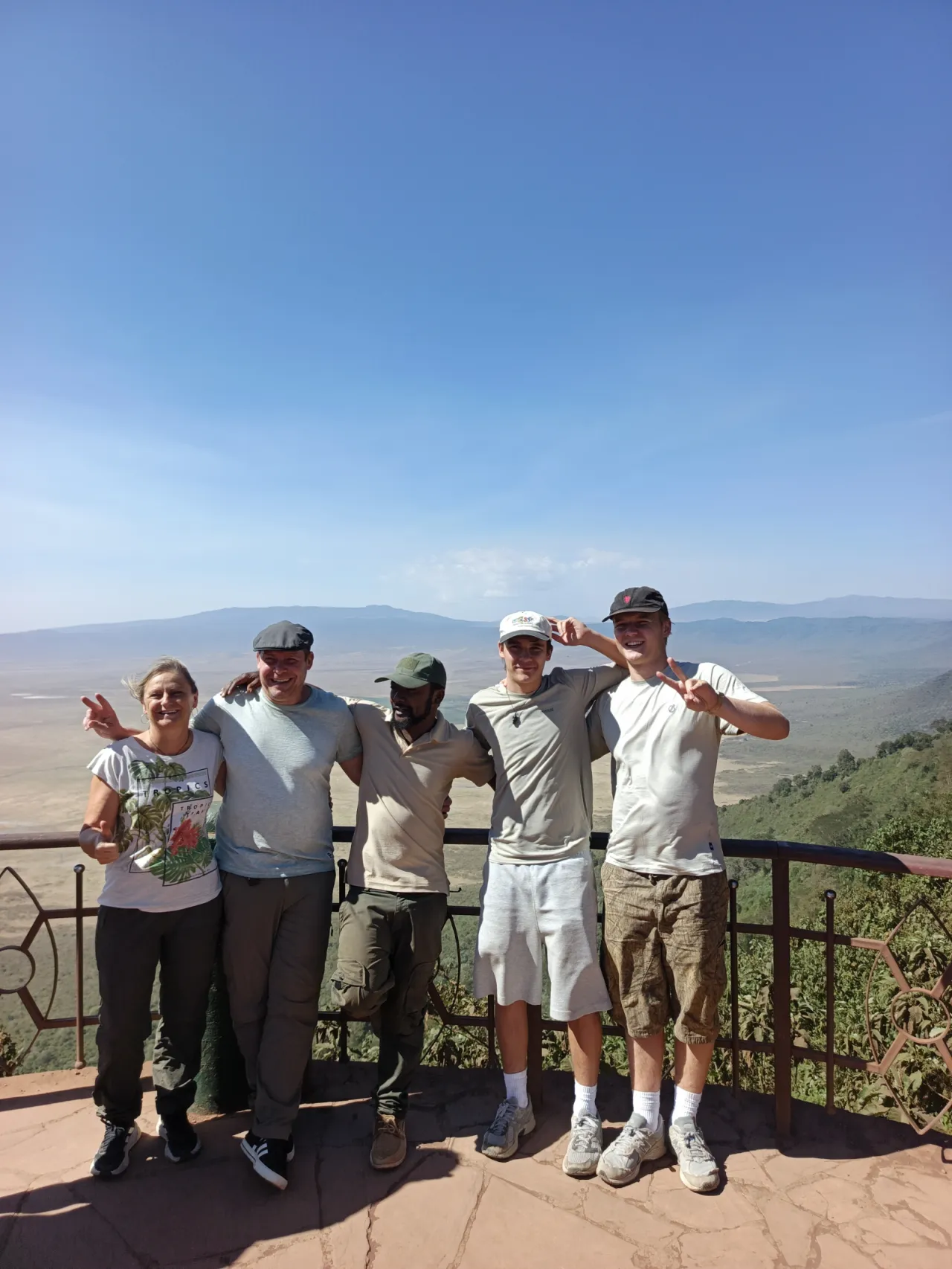
The Ngorongoro Crater is a volcanic caldera about 20 km across, roughly 610 m deep, with a floor of about 260 km². UNESCO describes it as the largest unbroken caldera in the world. The NCAA estimates more than 25,000 large animals live inside, most of them all year round, because water and grazing do not run out. The crater is one of the most reliable places in Tanzania to look for black rhino, usually at a distance, and lion, buffalo, elephant, spotted hyena, hippo and large herds of zebra and wildebeest are seen regularly. Only four-wheel-drive vehicles are allowed down, and you stay inside except at designated picnic sites.
After around five to six hours and a picnic lunch on the floor, you climb out in the early afternoon and drive back to Arusha, roughly 3.5–4 hours, arriving in the late afternoon or early evening. An evening flight from Kilimanjaro International Airport is usually possible, but check the timing with your guide first.
Destinations
Frequently asked questions
Is six days enough for a Tanzania safari?
Six days covers the four main northern-circuit parks at a reasonable pace, including two nights and a full day in the Serengeti. With seven or eight days you can add a third Serengeti night or split your stay between two areas of the park.
Where in the Serengeti will I stay?
It depends on the month. The central Serengeti around Seronera works all year; from about December to April the southern plains and Ndutu are usually better for the migration, and from around July to October the northern Serengeti is where most of the herds tend to be. The pattern varies each year.
What is the longest drive on this safari?
Day 3, from Karatu into the Serengeti, is the longest at around 6–7 hours including stops, but from Naabi Hill Gate onwards it is a game drive. The return from the crater to Arusha on the last day takes roughly 3.5–4 hours.
Can I add this safari to a Kilimanjaro climb?
Yes. Most people climb first and take the safari afterwards, with at least one rest night in Moshi or Arusha between the two. The first day is a short drive to Tarangire, which suits tired legs.