11-Day Kilimanjaro Machame Climb and Safari
Arrive at Kilimanjaro International Airport, climb to Uhuru Peak (5,895 m) on the seven-day Machame Route, then spend three days on safari in Tarangire, the Ngorongoro Crater and Lake Manyara before flying home on day 11.
- Duration
- 11 days
- Style
- Mid-range
- Travel
- Private safari
- Visits
- Kilimanjaro National Park, Tarangire National Park, Ngorongoro Conservation Area, Lake Manyara National Park
This trip pairs Kilimanjaro's most popular camping route with the classic short safari circuit near Arusha. You land at Kilimanjaro International Airport (JRO) and spend the first night in a hotel in Moshi or Arusha, where your guide checks your kit. Days 2 to 8 are the seven-day Machame Route: rainforest from Machame Gate (approx. 1,800 m), the Shira Plateau, the Lava Tower acclimatisation day, the Barranco Wall, Barafu Camp (approx. 4,670 m) and a midnight start for Uhuru Peak (5,895 m), then down to Mweka Gate.
This itinerary uses the seven-day version rather than six because the extra stage to Karanga Camp softens the climb to base camp, and a large study of Kilimanjaro hikers found each extra day on the mountain independently predicted summit success. After the climb you swap boots for a safari vehicle: Tarangire for elephants and baobabs, a morning on the floor of the Ngorongoro Crater, and Lake Manyara on the way back to the airport.
Climb first, safari second is the easier order. Your legs recover while you sit in a vehicle, and you are not carrying safari fatigue onto the mountain. The safari parks here are close to Arusha, so there is no long drive the day after you come down. Camp altitudes are approximate and match our Machame Route page.
Highlights
- Uhuru Peak (5,895 m) via the seven-day Machame Route
- Climb high, sleep low at Lava Tower (approx. 4,630 m)
- The Barranco Wall scramble and the southern glaciers
- Tarangire's elephant herds and baobab trees
- A morning on the Ngorongoro Crater floor
- Lake Manyara's groundwater forest on the way to your flight
- Airport-to-airport plan with no long drives after the climb
Day 1: Arrive at Kilimanjaro International Airport
You land at Kilimanjaro International Airport (JRO), which sits between Moshi and Arusha. After immigration and baggage, you are met in the arrivals hall and driven to your hotel, roughly 45 minutes to an hour depending on your hotel's location in Moshi or Arusha. On a clear afternoon you may see Kibo's summit above the clouds from the road; it is often hidden, so do not count on it.
Later in the day your lead guide comes to the hotel for a briefing. They explain the route, how each day works, what to expect from the altitude, and check your kit item by item: sleeping bag rating, waterproofs, warm layers for summit night, head torch, water bottles or bladder. Anything missing can be sorted before you leave. This is also the moment to mention any medical conditions or medication, including anything you have discussed with a travel-medicine doctor about altitude.
Then eat well, drink plenty of water and get a good night's sleep; long-haul fatigue is a poor start to a climb. Overnight: a hotel in Moshi or Arusha.
Day 2: Climb day 1: Machame Gate to Machame Camp
After breakfast you drive to Machame Gate (approx. 1,800 m) on the south-west side of the mountain, about an hour from Moshi. Registration with Kilimanjaro National Park takes a while as porters weigh loads and the crew organises the gear, so relax and have a snack.
The trail climbs steadily through montane forest, with tall trees, ferns and hanging moss, for about 11 km and five to seven hours. The gradient is constant rather than steep. Outside the dry seasons the path is muddy clay, so gaiters and trekking poles help. Listen for black-and-white colobus monkeys in the canopy. Your guide will keep the pace slow, sometimes slower than feels necessary; that is deliberate, because the first days set up your acclimatisation.
The forest thins towards the end and you reach Machame Camp (approx. 2,835 m) at the edge of the heath zone in the afternoon. Your tent is up when you arrive, there is tea and popcorn, and dinner is served in the mess tent. Temperatures drop quickly after dark. Accommodation: tented camp (Machame Camp).
Day 3: Climb day 2: Machame Camp to Shira 2 Camp
You leave the trees behind today. The trail climbs a steep, rocky ridge through giant heather and heath, with some sections where you step up over rock, and after about five to seven hours you come out onto the edge of the Shira Plateau. On a clear morning you get your first proper view of Kibo's summit cone and its glaciers, with Mount Meru to the west.
This is the hardest day for acclimatisation on the Machame Route. You sleep at Shira 2 Camp (approx. 3,850 m), about 1,000 m higher than last night, faster than altitude-medicine guidelines recommend. Expect to feel it: a mild headache, breathlessness on the uphill, a poor appetite. Tell your guide honestly how you feel at every check-in; hiding symptoms helps no one. Drink steadily all day, around three litres, and keep eating even if you do not feel like it.
Shira 2 sits on open moorland and is often cold and windy at night, so this is the first evening you will want your warm layers. Accommodation: tented camp (Shira 2 Camp).
Day 4: Climb day 3: Shira 2 to Barranco Camp via Lava Tower
The acclimatisation day. You climb east across the alpine desert, a landscape of volcanic gravel and boulders with almost no plants, towards Lava Tower, a tall volcanic plug at approx. 4,630 m. The walk up takes four to five hours at a slow, even pace. Lunch is at or near Lava Tower, and many people get their first real altitude headache here. That is the point: your body is being pushed to adapt.
From Lava Tower you descend about 670 m into the Barranco Valley, where giant groundsels (Dendrosenecio kilimanjari) stand like tree-sized cabbages along the stream. The total day is about six to eight hours. Sleeping lower than your high point is the textbook 'climb high, sleep low' approach, and most headaches ease on the way down.
Barranco Camp (approx. 3,960 m) sits under the great southern cliffs of Kibo and the Barranco Wall, which looks alarming from camp. Tomorrow's scramble is easier than it appears. Clear nights here can be spectacular, with the glaciers pale under the moon. Accommodation: tented camp (Barranco Camp).
Day 5: Climb day 4: Barranco Camp to Karanga Camp
Straight after breakfast you tackle the Barranco Wall, roughly 250 m of hands-on scrambling on a well-worn path. It takes one to two hours. You will use your hands on some steps and squeeze past a ledge known as the 'kissing rock', but you need no ropes or climbing skills. If you are nervous of heights, tell your guide the night before and they will walk right beside you. Mornings can bring queues here in busy season.
From the top of the wall the trail rolls east, up and down across ridges and valleys under the Heim and Kersten glaciers, to Karanga Camp (approx. 3,995 m). The whole day is about four to five hours and you arrive in time for lunch.
This short stage is what separates the seven-day Machame from the six-day version, which goes straight to Barafu. The extra night gives your body more time at around 4,000 m before the high camp. Spend the afternoon resting, drinking and eating. Karanga Valley is the last water source on this side, so porters carry water up from here. Accommodation: tented camp (Karanga Camp).
Day 6: Climb day 5: Karanga Camp to Barafu Camp
A short, steady climb of three to four hours up a dry, rocky ridge to Barafu Camp (approx. 4,670 m), the base camp for the summit. The name means 'ice' in Swahili, and the camp is exposed, rocky and often windy, with tents pitched on narrow ledges. Watch your footing around camp after dark.
You arrive for lunch, and the rest of the day is about preparation. Your guide will go through the summit plan, check your layers and make sure batteries, head torch and water are ready. Lay out everything you will wear tonight: base layers, fleece, insulated jacket, shell, warm gloves with liners, a hat, and a buff. Water bottles should be insulated or kept inside your jacket, as they can freeze on summit night.
Dinner is early, around 17:00, and then you try to sleep. Most people doze more than sleep at this altitude, which is normal. Your guide will check your health one last time and agree with you if you are fit to continue. Accommodation: tented camp (Barafu Camp).
Day 7: Climb day 6: summit via Stella Point to Uhuru Peak, down to Mweka Camp
Wake around 23:00 for tea and biscuits, then leave Barafu near midnight by head torch. The climb to the crater rim gains about 1,200 m on a steep path of scree and rock, zigzagging slowly upwards. It is usually well below freezing, and the hours between 03:00 and 05:00 are the hardest: cold, dark and relentless. Your guides keep you moving in small steps and make you drink at every stop.
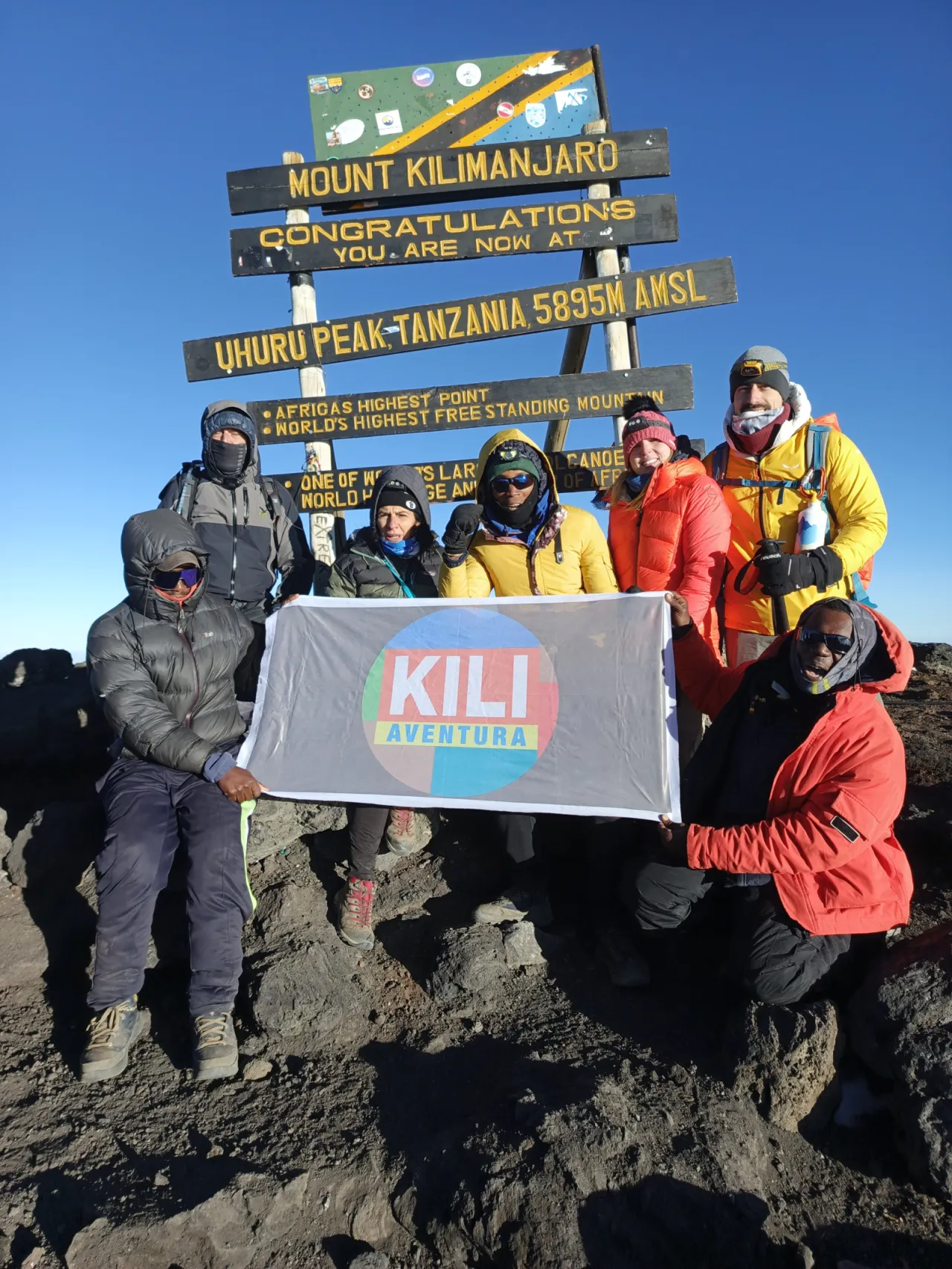
Most climbers reach Stella Point (approx. 5,756 m) on the crater rim around sunrise, after six to seven hours. From there it is another hour or so, gently uphill along the rim past the glaciers, to Uhuru Peak (5,895 m), the highest point in Africa. You spend only a few minutes at the top for photos before heading down.
The descent to Barafu takes two to three hours, sliding down the scree. You rest, have a meal and pack, then continue down for another two to three hours to Mweka Camp (approx. 3,100 m) in the heath zone. The whole day can run to 12 to 15 hours. Thicker air and a proper dinner feel wonderful. Accommodation: tented camp (Mweka Camp).
Day 8: Climb day 7: Mweka Camp to Mweka Gate and back to town
The last morning on the mountain. After breakfast many crews gather to sing and say goodbye, and it is a good time to thank the porters by name. Then you walk down through the montane forest for three to four hours to Mweka Gate (approx. 1,640 m). The path is steep and can be slippery when wet, and your thighs and knees will feel yesterday's 2,500 m descent, so take it steadily and use your poles.
At Mweka Gate you sign out of the park, and climbers who reached Stella Point or Uhuru Peak collect their summit certificates. A vehicle takes you back to your hotel in Moshi or Arusha, about an hour's drive, for the first hot shower in a week.
This afternoon is for rest. Hand back any rental gear, wash what you need for safari and repack: the safari needs little more than light clothes, a warm layer for the crater rim, sunscreen and binoculars. Eat and drink well; your body has been working hard. Overnight: a hotel in Moshi or Arusha.
Day 9: Safari day 1: Tarangire National Park
A relaxed start. Your safari guide collects you from your hotel at about 08:00 and drives you to Tarangire National Park, about 121 km from Arusha, roughly one and a half to two hours to the main gate (add about an hour and a half if you start in Moshi). It is an easy day for tired legs: the pop-up roof lets you stand when there is something to see and sit when there is not.
Tarangire is known for big elephant herds and baobab trees, some of them many centuries old. What you see depends on the season. In the dry months, roughly July to November, the Tarangire River and swamps such as Silale are the main water for a wide area and wildlife concentrates along them. In the green season, about December to May, the animals spread onto the surrounding Maasai Steppe and the park feels emptier, though birding is excellent. Lion, leopard, buffalo, giraffe and zebra are present all year.
After a picnic lunch and an afternoon game drive, you drive to Karatu in the Ngorongoro highlands, about two hours. The woodland has tsetse flies, so wear light, neutral colours. Overnight: a lodge or tented camp.
Day 10: Safari day 2: Ngorongoro Crater
An early start, with a packed breakfast, to be on the crater floor while it is quiet. From Karatu it is about 30 to 45 minutes to the entrance gate, then up through montane forest to the rim at around 2,200 m, where mornings are cold and often misty.
The Ngorongoro Crater is a collapsed volcano about 20 km across, with a floor of almost 260 km² some 610 m below the rim, according to the Ngorongoro Conservation Area Authority (NCAA). Only four-wheel-drive vehicles may go down, and you stay in the vehicle. Water and grazing are available all year, so more than 25,000 large animals live here: buffalo, wildebeest, zebra, hippo, spotted hyena and some very visible lions. It is one of the best places in Tanzania to look for black rhino, although they often keep their distance.
You spend most of the day on the floor, with a picnic lunch near one of the designated sites, and drive back up to the rim before the afternoon is out. The Ngorongoro Conservation Area is shared with Maasai pastoralists, and you will pass herders and their cattle on the road. Back to Karatu for the night. Overnight: a lodge or tented camp.
Day 11: Safari day 3: Lake Manyara National Park and departure
After breakfast you drive down the escarpment to Lake Manyara National Park, about 30 km and under an hour from Karatu. The park stretches along the foot of the Great Rift Valley wall, and this morning's game drive starts in its groundwater forest, fed by springs from the escarpment, where olive baboons and blue monkeys are common.
Further in, the forest opens onto acacia woodland and floodplain along the soda lake, with elephant, buffalo, giraffe and hippo. Lions here sometimes rest in trees, though that is never predictable. Birders do well: the park has more than 390 recorded species, and flamingos gather on the lake at some times of year.
After lunch you leave the park and drive back through Mto wa Mbu and Arusha to Kilimanjaro International Airport (JRO), about three hours from Manyara, in time for an evening international flight. If your flight leaves earlier in the day, add a night in Arusha before this day.
Destinations
Frequently asked questions
Is it better to climb Kilimanjaro before or after a safari?
Most people climb first. You arrive fresh for the mountain, and the safari lets your legs recover while you sit in a vehicle. It also means any delay on the mountain does not cut into a safari you have already started.
Why seven days on the Machame Route instead of six?
The seventh day adds a short stage from Barranco to Karanga Camp before Barafu, giving you another night at around 4,000 m. A 2022 study of 1,237 Kilimanjaro hikers found that each extra day on the mountain independently predicted summit success.
Do I need to bring different clothes for the safari?
Only a few. Light, neutral-coloured clothes, a hat, sunscreen and a warm layer for the cold mornings on the Ngorongoro Crater rim are enough. Much of your trekking kit, such as a fleece and a waterproof, works on safari too.
Will I be too tired for a safari after the climb?
Most people feel tired but fine. The safari parks in this itinerary are close to Arusha, so there are no very long drives, and game drives involve almost no walking. Expect sore thighs for a couple of days after the descent.