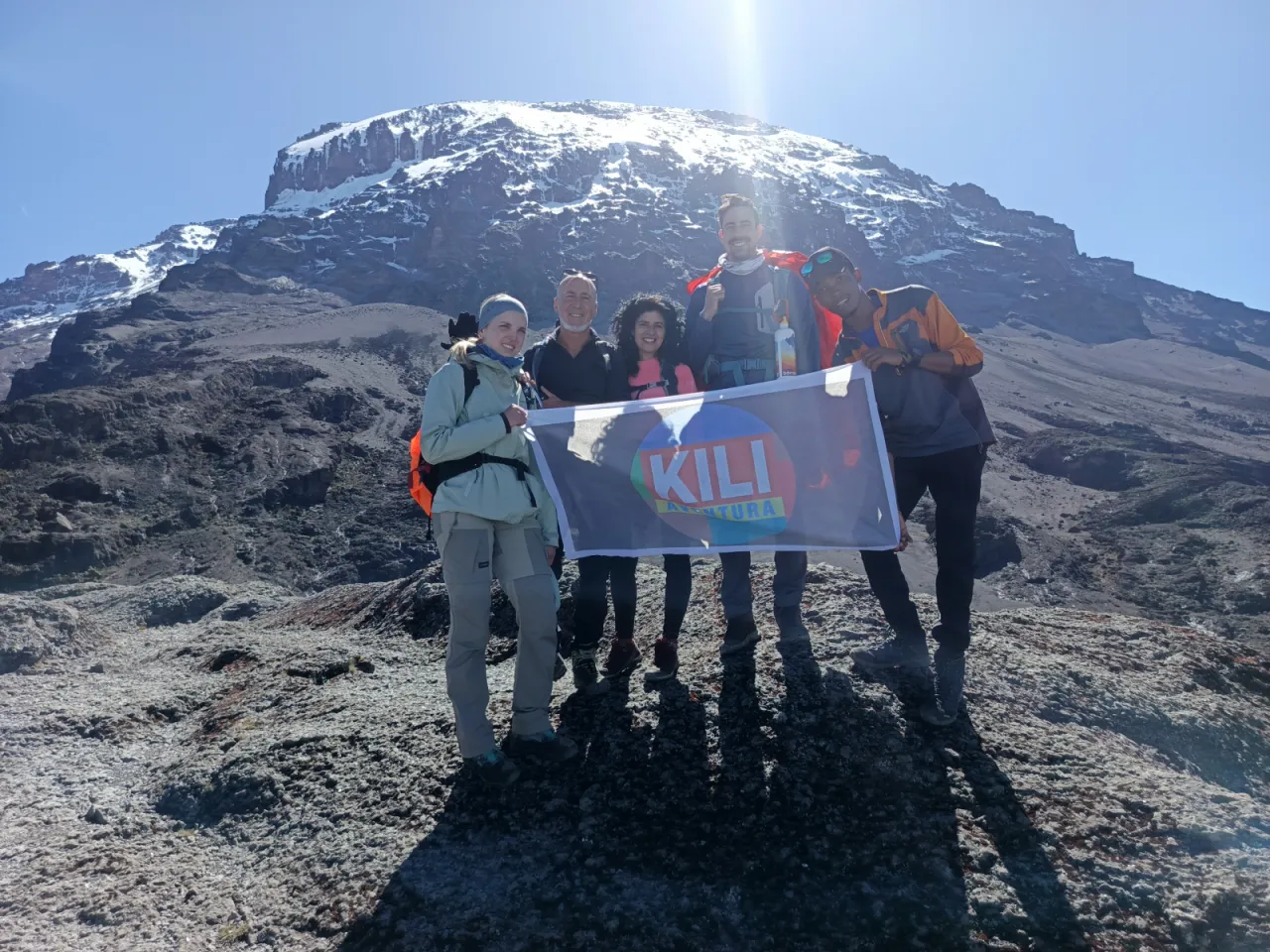
Kilimanjaro National Park
The national park around Mount Kilimanjaro: 1,712 km² of montane forest, moorland, alpine desert and glaciated summit, established in 1973 and a UNESCO World Heritage Site since 1987.
Key facts
- Area
- 1,712 km² (TANAPA); the UNESCO World Heritage property covers 75,575 ha
- Established
- 1973; extended in 2005 to include the montane forest
- UNESCO status
- World Heritage Site since 1987
- Summit
- Uhuru Peak on Kibo, 5,895 m, the highest point in Africa
- Volcanic cones
- Kibo 5,895 m, Mawenzi 5,149 m, Shira 3,962 m
- Climate zones
- Montane forest, heath and moorland, alpine desert and the summit zone, above the cultivated lower slopes
- Park headquarters
- Marangu, about 86 km from Kilimanjaro International Airport (JRO)
Kilimanjaro National Park protects Mount Kilimanjaro, Africa's highest mountain, whose summit, Uhuru Peak on the Kibo cone, stands at 5,895 m. The park was established in 1973 and extended in 2005 to take in the natural montane forest that had been the Kilimanjaro Forest Reserve. Tanzania National Parks (TANAPA) gives its area as 1,712 km². UNESCO inscribed it as a World Heritage Site in 1987.
UNESCO describes Kilimanjaro as the largest free-standing volcanic mass in the world, rising about 4,877 m above the surrounding plains. It has three volcanic cones: Kibo (5,895 m), Mawenzi (5,149 m) and Shira (3,962 m), the oldest, which collapsed to form the Shira Plateau.
Most visitors come to climb, and this page covers the park itself. For route-by-route detail, days on the mountain and how to prepare, go to our Kilimanjaro section and the routes overview.
When to go
The park is open all year and climbs run in every month. The two dry seasons, roughly late June to October and January to early March, give the best odds of clear skies and firm trails. The long rains (about March to May) and the short rains (around November) bring more cloud, mud in the forest and snow higher up. See our month-by-month guide to the best time to climb for the detail.
Safaris visiting Kilimanjaro National Park
What are Kilimanjaro's climate zones?
Climbing Kilimanjaro takes you through a sequence of zones that TANAPA compares to travelling from the equator to the Arctic in a few days. UNESCO lists five: the lower slopes, montane forest, heath and moorland, alpine desert and the summit.
- Montane forest rings the whole mountain from about 1,800 to 2,800 m. It is wet, green and the richest zone for wildlife, and TANAPA describes it as a water tower for the many people who live on the lower slopes.
- Heath and moorland come next, more open and with far less shelter from sun and wind.
- Alpine desert is dry, stony and exposed.
- The summit zone around Kibo's crater, where TANAPA notes snow lies all year and glaciers survive near the equator.
Our Kilimanjaro weather guide explains what each zone feels like on the trail.
What wildlife lives in Kilimanjaro National Park?
More than most climbers expect, though much of it stays hidden in the forest. TANAPA records around 140 mammal species, including 7 primates, 25 carnivores, 25 antelopes and 24 bats, and more than 179 bird species. In the forest you may see black-and-white colobus and blue monkeys and hear forest duikers crashing away. Buffalo, elephant and eland range across the Shira Plateau, but sightings on the climbing routes are uncommon.
Higher up, the white-necked raven, lammergeier and alpine chat are the birds you are most likely to see. The Kilimanjaro mountain shrew is found nowhere else on earth, and the forest holds endemic plants such as Impatiens kilimanjari.
How many routes are there up Kilimanjaro?
TANAPA's brochure lists at least seven routes, taking five to nine days or longer. The main ones are Marangu, Machame, Lemosho, Rongai, Umbwe and the Northern Circuit, each with different scenery, traffic and acclimatisation profiles. We cover them in detail on separate pages rather than repeating it here:
- Machame and Lemosho from the south-west
- Marangu, the hut route
- Rongai from the north
- Northern Circuit, the longest
- Umbwe, the steepest
Not sure which suits you? Try the route finder or the route comparison.
What else can you do in the park besides climbing to the summit?
TANAPA lists several activities beyond the standard summit climb:
- Forest day walks: nature trails through the montane forest belt, worth doing even if you are not climbing.
- Mountain cycling: the Kilema route for summit-bound cyclists and the Shira Plateau for non-summit rides.
- Crater camping inside Kibo's crater, near its distinctive glaciers.
- Technical climbing on Mawenzi, a rugged peak with cliffs, gullies and several sub-peaks.
- Paragliding from high on the mountain, by special arrangement.
- Kifinika cultural site on the Marangu route, a place sacred to the Chagga people.
Crater camping, Mawenzi and paragliding need specialist planning; ask well in advance.
How do you get to Kilimanjaro National Park?
Kilimanjaro International Airport (JRO) is the main arrival point for international visitors. Most climbers stay a night in Moshi or Arusha before driving to their starting gate. The park headquarters is at Marangu, about 86 km from JRO, and the gates for the other routes are spread around the southern, western and northern sides of the mountain.
Can you combine Kilimanjaro with a safari?
Yes, and many people do. TANAPA notes that Arusha, Tarangire and Lake Manyara national parks are all within a day's drive of Moshi, while the Serengeti is best reached by a longer drive or a short flight. The usual order is climb first, rest a day, then safari. See Kilimanjaro and safari, or the pages for Arusha National Park, Tarangire and the Serengeti. When you are ready to plan, you can ask Kili Aventura for a quote.
Sources
- UNESCO World Heritage Centre — Kilimanjaro National Park
- Tanzania National Parks (TANAPA) — Kilimanjaro National Park
- Tanzania National Parks (TANAPA) — National parks brochure
- Tanzania National Parks (TANAPA) — Northern Zone national parks quick reference guide (October 2024)
Checked 2026-09-25.
Frequently asked questions
When was Kilimanjaro National Park established?
In 1973. It was extended in 2005 to include the natural montane forest that had been part of the Kilimanjaro Forest Reserve, and it has been a UNESCO World Heritage Site since 1987.
How big is Kilimanjaro National Park?
TANAPA gives the area as 1,712 km². The UNESCO World Heritage property, as inscribed in 1987, covers 75,575 ha.
Can you visit Kilimanjaro National Park without climbing to the summit?
Yes. You can do day walks in the montane forest, cycle on the Shira Plateau or visit the lower slopes for the views. All activities inside the park require park fees and, for hiking, a licensed guide.
What animals can you see on Kilimanjaro?
In the forest, black-and-white colobus and blue monkeys are the most commonly seen. Larger animals such as buffalo, elephant and eland live on the mountain, especially around the Shira Plateau, but climbers rarely see them. Higher up, ravens and lammergeiers are common.
Who manages Kilimanjaro National Park?
Tanzania National Parks (TANAPA), the government authority that manages Tanzania's national parks. The park headquarters is at Marangu on the south-eastern side of the mountain.