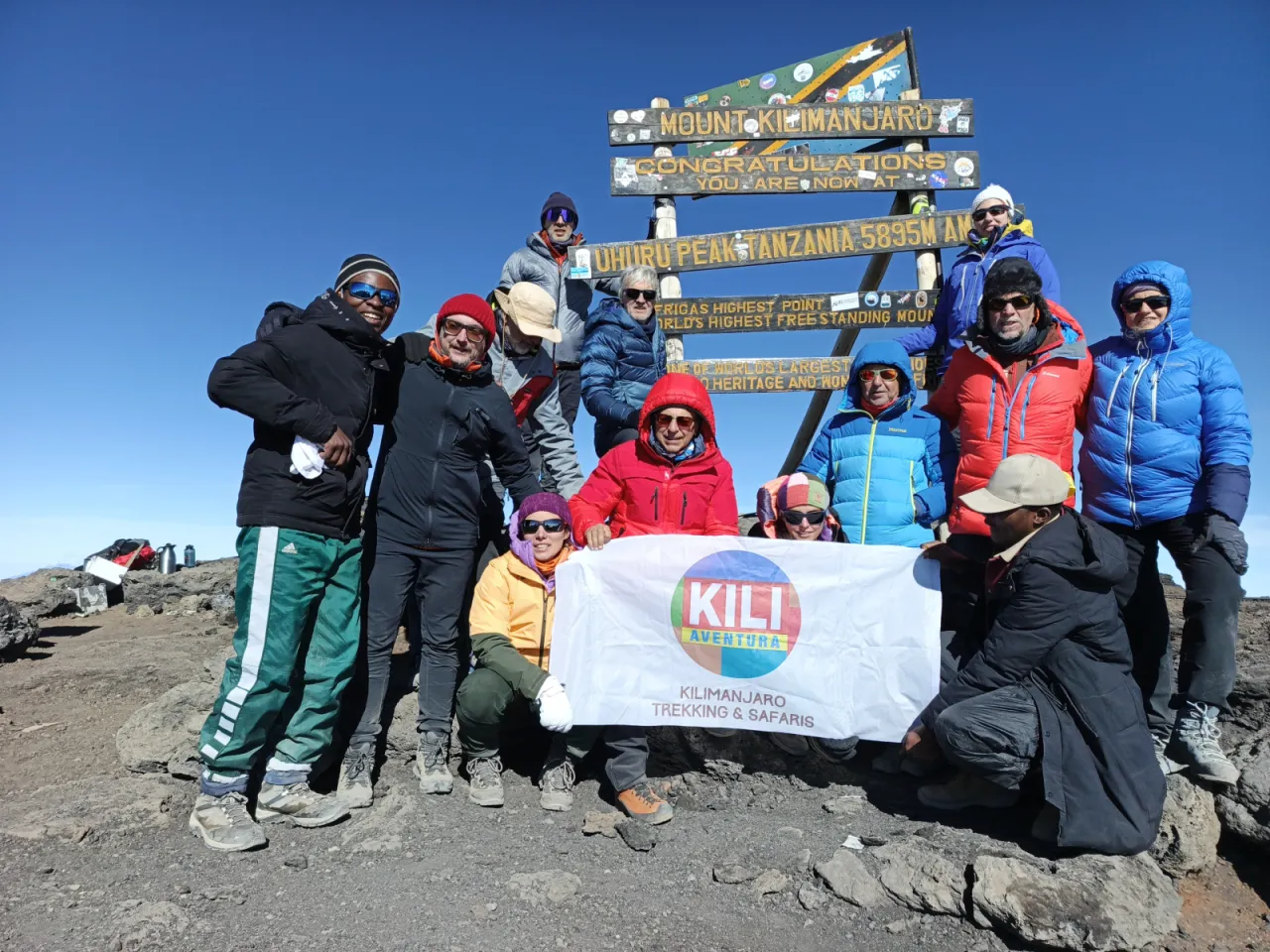
13-Day Kilimanjaro Lemosho Climb and Safari
Arrive at Kilimanjaro International Airport, climb to Uhuru Peak (5,895 m) on the eight-day Lemosho Route, then a four-day safari through Tarangire, the Ngorongoro Crater and the Serengeti, with a flight out on day 13 to connect with your journey home.
- Duration
- 13 days
- Style
- Mid-range
- Travel
- Private safari
- Visits
- Kilimanjaro National Park, Tarangire National Park, Serengeti National Park, Ngorongoro Conservation Area
This is the longer, gentler way to combine Kilimanjaro with a proper safari. After a night in Moshi or Arusha, you spend eight days on the Lemosho Route: a long drive round to Londorossi Gate, quiet forest to Mti Mkubwa Camp (approx. 2,780 m), two days across the Shira Plateau, then the southern traverse via Lava Tower, Barranco and Karanga to Barafu Camp (approx. 4,670 m) and Uhuru Peak (5,895 m). You come down to Mweka Gate on day 9.
Lemosho's first three nights climb gradually, to about 2,780 m, 3,505 m and 3,850 m, instead of jumping around 1,000 m on the second night as the Machame Route does. That, and eight days on the mountain, is why many guides rate it one of the better acclimatisation profiles for first-timers. No standard itinerary fully meets altitude-medicine guidelines, but longer is generally better: a study of 1,237 Kilimanjaro hikers found each extra day independently predicted summit success.
The four-day safari starts with an easy day in Tarangire, then the Ngorongoro Crater and two nights in the Serengeti, where the area you visit depends on the season and where the migration herds are. On the last morning you fly from the Serengeti rather than driving back, so there is no long road day before your international flight. Camp altitudes match our Lemosho Route page.
Highlights
- Uhuru Peak (5,895 m) via the eight-day Lemosho Route
- Quiet western forest and a full crossing of the Shira Plateau
- Gradual first nights for better acclimatisation
- Climb high, sleep low at Lava Tower (approx. 4,630 m)
- Tarangire's elephants and baobabs
- A morning on the Ngorongoro Crater floor
- Two nights in the Serengeti, with a flight out on the last day
Day 1: Arrive at Kilimanjaro International Airport
You land at Kilimanjaro International Airport (JRO), between Moshi and Arusha, and are met after immigration and baggage for the drive to your hotel, roughly 45 minutes to an hour. If the cloud lifts, Kibo's summit may appear above the plains on the way; it hides more often than it shows.
In the late afternoon your lead guide comes to the hotel for a briefing. Expect a careful kit check: sleeping bag rating, waterproof jacket and trousers, insulated jacket and gloves for summit night, boots that are broken in, head torch with spare batteries, and enough water capacity for three litres a day. They will also talk through how the Lemosho days work, what altitude symptoms to report, and the long drive to the start tomorrow. Mention any medical conditions or medication you have discussed with a travel-medicine doctor.
Pack a small bag for the hotel to store while you are on the mountain, with clean clothes for after the climb and anything you need only for the safari. Then have an early dinner and sleep. Overnight: a hotel in Moshi or Arusha.
Day 2: Climb day 1: Londorossi Gate to Mti Mkubwa Camp
An early breakfast, then a long drive west round the mountain to Londorossi Gate, through farmland and forest plantations on Kilimanjaro's western slopes. Registration with Kilimanjaro National Park takes time while porters' loads are weighed, and then you drive on along a forest track to the Lemosho trailhead (approx. 2,390 m). Most of the morning goes on getting here, which is why today's walk is short.
The trail runs through tall, quiet montane forest, some of the least visited on the mountain, with moss-draped trees, ferns and occasional glimpses of black-and-white colobus monkeys. The path climbs gently, with a few steeper sections and some mud if it has rained. After two to four hours of walking you reach Mti Mkubwa Camp (approx. 2,780 m), whose name means 'big tree' in Swahili.
The crew has the tents up and hot water ready. The forest is damp and dark early, and you fall asleep to the sound of the trees and, sometimes, bush babies calling. Accommodation: tented camp (Mti Mkubwa Camp).
Day 3: Climb day 2: Mti Mkubwa Camp to Shira 1 Camp
You leave the forest early in the morning and climb into the heath zone, where giant heather grows taller than you and the views open up behind you across the western plains. The path is steady and in places steep as it climbs onto the ridge that forms the western rim of the Shira Plateau. Allow about five to six hours at an easy pace.
From the rim you get the first sweeping view of Kibo rising beyond the plateau, and on clear days Mount Meru floats to the west. Then the trail drops gently onto the plateau itself, a wide, open moorland that is the collapsed remains of Shira, the oldest of Kilimanjaro's three volcanic cones. TANAPA notes that the plateau is habitat for buffalo, elephant and eland, but sightings on foot are uncommon.
Shira 1 Camp (approx. 3,505 m) is a gain of about 700 m on last night, so walk slowly and drink plenty. Some people notice the altitude for the first time here. Nights on the plateau are cold and clear, and the stars are superb. Accommodation: tented camp (Shira 1 Camp).
Day 4: Climb day 3: Shira 1 Camp to Shira 2 Camp
An easier day, and a useful one for acclimatisation. You cross the Shira Plateau from west to east over open moorland of tussock grass, heather and scattered volcanic rock, with Kibo's glaciers getting closer all morning. The gradient is gentle and the walking takes about three to five hours, arriving at Shira 2 Camp (approx. 3,850 m) around lunchtime.
Depending on the weather and how the group feels, your guide may add a short detour, for example towards the rock formation known as the Shira Cathedral, to climb a little higher before coming back down to camp. Short gains and returns like this help your body adjust, and the afternoon gives you time to rest.
Shira 2 is where Lemosho meets the Machame Route, so the camp is busier than the last two nights. You have reached this altitude a day later than a Machame climber, with a gentler build-up, which is the main acclimatisation advantage of Lemosho. Use the afternoon to rest, drink and eat. The evening can be windy and cold, with Mount Meru silhouetted at sunset. Accommodation: tented camp (Shira 2 Camp).
Day 5: Climb day 4: Shira 2 to Barranco Camp via Lava Tower
The key acclimatisation day of the climb. From Shira 2 you walk east into the alpine desert, a grey-brown world of gravel, boulders and lichen, climbing steadily for four to five hours to Lava Tower, a tall volcanic plug at approx. 4,630 m. That is higher than you will sleep until Barafu. Lunch is here, in the cold and often cloud, and a headache is common. Tell your guide.
Then you descend about 670 m into the Barranco Valley, where streams run between giant groundsels and lobelias, plants adapted to the cold of East Africa's high mountains. The total walking day is about six to eight hours, and most people feel noticeably better by the time they reach camp. Climbing high and sleeping lower is the logic behind the whole day.
Barranco Camp (approx. 3,960 m) sits under the towering southern cliffs of Kibo, facing the Barranco Wall you will climb tomorrow. It is one of the most dramatic campsites on the mountain, busy with groups from the Machame and Umbwe routes. Accommodation: tented camp (Barranco Camp).
Day 6: Climb day 5: Barranco Camp to Karanga Camp
First thing in the morning comes the Barranco Wall, a steep rock face of roughly 250 m climbed on a well-trodden path in one to two hours. It is a scramble rather than a climb: you use your hands on some steps and edge past a narrow point called the 'kissing rock', but there are no ropes. Tell your guide if heights worry you.
From the top of the wall the views of the southern glaciers are superb. The path then undulates east through the alpine desert, crossing a couple of valleys, down into the Karanga Valley and up to Karanga Camp (approx. 3,995 m). The whole day takes about four to five hours, so you arrive around lunchtime.
This short day is about recovery and adaptation before base camp. Rest in the afternoon, keep drinking and eat everything you can. The camp looks up at Kibo's southern face, and on clear evenings you can watch the light fade on the Heim and Kersten glaciers. Accommodation: tented camp (Karanga Camp).
Day 7: Climb day 6: Karanga Camp to Barafu Camp
A short but steady climb of three to four hours up a rocky, dry ridge to Barafu Camp (approx. 4,670 m), the base camp for the summit. There is little vegetation left, and the camp is a scatter of tents on rock ledges, exposed to the wind. 'Barafu' means ice in Swahili, and the night here will show you why.
You arrive for lunch and spend the afternoon preparing. Your guide runs through the summit plan, the timings and the turnaround rules. Lay out your summit clothes in the order you will put them on: base layers, fleece, insulated jacket and waterproof shell, warm gloves with liners, hat and buff. Put fresh batteries in your head torch and keep a spare set warm. Insulate your water bottles or carry them inside your jacket; they can freeze on the way up.
Dinner is early, around 17:00, and then you rest. At this altitude most people doze rather than sleep, which is normal. Your guide checks everyone's health one final time before the summit attempt. Accommodation: tented camp (Barafu Camp).
Day 8: Climb day 7: summit via Stella Point to Uhuru Peak, down to Mweka Camp
You wake around 23:00, have a hot drink and a snack, and leave Barafu by head torch near midnight. The path climbs about 1,200 m up steep scree and rock in tight zigzags to the crater rim. It is usually well below freezing, often windy, and the hours before dawn are the hardest of the whole trip. Your guides set a very slow rhythm and make you drink and eat at each short stop.
Stella Point (approx. 5,756 m) on the rim usually comes around sunrise, after six to seven hours. The sky lightens over Mawenzi and the glaciers turn pink. From there it is roughly another hour along the rim to Uhuru Peak (5,895 m), the highest point in Africa. You stay only long enough for photos.
Descending to Barafu takes two to three hours down loose scree. After a rest, a meal and packing up, you continue down another two to three hours to Mweka Camp (approx. 3,100 m) in the heath zone, where the thicker air feels like a gift. The whole day can take 12 to 15 hours. Accommodation: tented camp (Mweka Camp).
Day 9: Climb day 8: Mweka Camp to Mweka Gate and back to town
The final descent. After breakfast and, often, a song from the crew, you walk down through heath and then montane forest for three to four hours to Mweka Gate (approx. 1,640 m). The path is steep in places and slippery after rain, and your legs will be stiff from the summit day, so use your poles and take small steps.
At the gate you sign out of Kilimanjaro National Park and receive your summit certificate if you reached Stella Point or Uhuru Peak. Say goodbye to the crew, who have carried, cooked and cared for you for eight days. A vehicle then takes you back to your hotel in Moshi or Arusha, about an hour away, for a long hot shower.
Spend the afternoon resting and sorting your kit: return anything rented, wash what you need, and pack for safari. You need light, neutral-coloured clothes, a warm layer for the crater rim, sunscreen, a hat and binoculars. If the light-aircraft flight on day 13 has a soft-bag rule, repack into a soft bag now. Overnight: a hotel in Moshi or Arusha.
Day 10: Safari day 1: Tarangire National Park
A deliberately gentle first safari day. Your guide collects you at about 08:00 and drives to Tarangire National Park, about 121 km from Arusha and roughly one and a half to two hours to the main gate (longer from Moshi). There is no walking to speak of: you stand in the pop-up roof when there is something to see and sit when there is not, which suits post-climb legs very well.
Tarangire is known for large elephant herds and huge baobab trees. In the dry season, roughly July to November, the Tarangire River and the Silale swamp are the main water for a wide area, and wildlife concentrates there in numbers TANAPA ranks second only to the Ngorongoro Crater around October. In the green season, about December to May, the animals spread out onto the Maasai Steppe, the park is quieter and the birding is excellent. Lion, leopard, buffalo, zebra and giraffe live here all year.
After a picnic lunch and afternoon game drive you continue to Karatu in the Ngorongoro highlands, about two hours. Wear light colours; the woodland has tsetse flies. Overnight: a lodge or tented camp.
Day 11: Safari day 2: Ngorongoro Crater to the Serengeti
A dawn start with a packed breakfast to be among the first vehicles down into the Ngorongoro Crater. The crater is a collapsed volcano about 20 km across, with a floor of almost 260 km² some 610 m below the rim (NCAA figures). Only four-wheel-drive vehicles are allowed down, and you stay in the vehicle. More than 25,000 large animals live on the floor, including buffalo, wildebeest, zebra, hippo, spotted hyena and lion, and it is one of the most reliable places in Tanzania to look for black rhino.
After about four to five hours in the crater you climb back to the rim and head west across the highlands, past Maasai herders and their cattle, and down to the plains. Naabi Hill Gate, the main entrance to Serengeti National Park, is about two and a half to three hours from the rim, and the central Serengeti around Seronera roughly another hour and a half.
The last part of the drive is a game drive, with the huge short-grass plains giving way to kopjes and acacia along the Seronera River. Overnight in the Serengeti: a lodge or tented camp.
Day 12: Safari day 3: full day in the Serengeti
A full day in Serengeti National Park, 14,763 km² of plains, kopjes and riverine woodland. Where you drive depends on the month. From about December to April the migration herds are usually on the southern plains and around Ndutu; from about April to June many move through the central and western Serengeti; from around July to October many are in the north near the Mara River. Those are typical patterns, and the herds' timing varies every year with the rain.
Whatever the season, the central Serengeti around Seronera has resident wildlife all year, and it is one of the best areas in Tanzania for big cats. Lions rest on the granite kopjes, leopard lie up in the trees along the Seronera River, and cheetah hunt the open plains. Your guide will talk to other guides by radio and plan the day around the latest news.
Most days start at first light and include a picnic lunch out in the park, or a return to camp for the hottest hours, then a late-afternoon drive until close to sunset. Overnight in the Serengeti: a lodge or tented camp.
Day 13: Safari day 4: morning game drive, flight out and departure
A last early game drive while the Serengeti is cool and the predators are active, then breakfast and packing. Your guide takes you to the nearest airstrip, usually Seronera, for a scheduled light-aircraft flight back towards Arusha or Kilimanjaro International Airport (JRO). The flight often makes one or more stops at other airstrips and takes a couple of hours; seen from the air, the plains you drove across show how big this ecosystem is.
Light aircraft have strict luggage limits and usually require soft bags, so pack with this flight in mind from the start of the trip. Your guide and vehicle drive back to Arusha by road, a full day's journey.
Depending on the schedule, you land around midday or in the afternoon and are met for the transfer to JRO for an evening international flight, or to a hotel if you are staying on. If your international flight leaves before the evening, add a night in Arusha rather than risk a missed connection.
Destinations
Frequently asked questions
Why choose Lemosho rather than Machame for a climb and safari trip?
Lemosho spends eight days on the mountain and builds altitude more gradually in the first three nights, which gives most people a better chance to acclimatise. It also crosses the whole Shira Plateau and starts in quieter forest. The trade-off is one more day and a longer drive to the start.
Can I see the Great Migration on this trip?
Possibly, depending on when you travel. The herds are usually in the southern Serengeti from about December to April and in the north from around July to October, but their timing varies each year. With only two nights in the Serengeti, the itinerary goes where the herds are likely to be within reach.
Is one rest day needed between the climb and the safari?
This itinerary uses the afternoon of the descent day as rest and keeps the first safari day short, in Tarangire, before the longer drive to the Serengeti. If you prefer a full rest day, you can add a night in Moshi or Arusha after the climb.
Why fly out of the Serengeti instead of driving back?
The drive from the central Serengeti back to Arusha takes most of a day. Flying out gives you a final morning game drive and gets you close to Kilimanjaro International Airport in time for an evening flight.